Showing posts with label water quality. Show all posts

Tuesday, August 14, 2012

Westchester Sewage Release

On Thursday 8/9/2012, I sampled at the two discharge points, Yonkers and Tarrytown, both inshore and offshore. I also sampled at Irvington between the discharges and at Ossining because it had been flooding past both discharge points. Five of seven samples were “acceptable” – very low contamination.

All stations sampled (except exploratory site at Castle Oil at border of Tarrytown and Sleepy Hollow) are regular Riverkeeper monthly sampling locations.

If you look at our historical data at these sample sites you’ll see that contamination is often present and significant – when there is NOT a sewer main break. Chronic wet weather discharges are the real problem, not the accidents.

Yonkers mid channel: sampled at 1400, Entero MPN <10/100ml, flooding
Yonkers inshore at mouth of Saw Mill (one discharge was in Saw Mill): sampled at 1410, Entero MPN 10/100ml, flooding
Irvington at Boat Club beach: sampled at 1505, Entero MPN <10/100ml, flooding
Tappan Zee mid channel: sampled at 1555, Entero MPN <10/100ml, flooding
Tarrytown Marina (one discharge was in Andre Brook, off Marina): sampled at 1610, Entero MPN >24,200, high tide, smelly, discolored grey, brown water
Castle Oil terminal (one discharge near kayak launch here): sampled at 1725, Entero MPN 84/100ml, high tide, now odor or discoloration.
Ossining moorings and beach: sampled at 1810, Entero MPN <10/100ml, end of flood.

EPA guideline: Over 104 Entero/100ml is “unacceptable” for swimming and primary contact 

The estimated volume of the Westchester discharge was approx. 3 million gallon/day – it flowed about 29 hours / approx. 3.4 million gallons

For contrast, NYC discharges 28 BILLION gallons from CSOs annually – combined rain water and sewage.

About 20% of that is sewage – so 5.6 billion gallons is the sewage component.

Assuming 50 CSO events per year we get an average 112 million gallons of SEWAGE per CSO event – some more, some less.

So this Westchester release was minor compared with the chronic releases in NYC and elsewhere during rain events.

Regarding the Ironman Triathlon, I think the swimmers probably lucked out. Although it rain hard on Friday it did not rain all that long and then the rain held off overnight. My guess is that they had acceptable WQ Saturday morning. I was tempted to go early and sample but didn’t because IF the WQ had been bad we would have appeared to be real spoilers publicizing it after the fact. I want to address this issue without beating up on people.

And of course next year NYC will have to notify when CSOs deploy because RIVERKEEPER GOT THE “SEWAGE RIGHT TO KNOW ACT PASSED!

Saw Mill river entering Hudson at Yonkers. Sewage discharge was into Saw Mill a short distance inland 
Beach at Irvington Boat Club 
A guy crabbing right at the entrance to Tarrytown Marina. He didn’t want to hear about a sewage spill. 
Cloudy surface layer in Tarrytown Marina 

Andre Brook empties into Tarrytown Marina. There is a CSO or Bypass in Andre Brook 

SPDES sign at discharge point in Andre Brook 

Andre Brook 

Castle Oil / kayak launch. Chlorine tanker visible inland. Health Department was chlorinating this outfall. 


Monday, April 02, 2012

Storm Drains Mitigate Pollution in Nyack

As the sampling season rapidly approaches, we're reminded of how much trash we pickup each time we're out on the river.  Trash often washes into the river during rainstorms from the streets and our communities through drains like the one below.


Nyack is replacing these traditional open-sided storm drains with these newer models which will prevent plastic trash from entering the river via storm drains.

Bravo and thank you Nyack!

Here's what they look like:


Hudson Valley residents can join cleanups in their own communities as part of the Riverkeeper Sweep on June 2. For more information, visit riverkeeper.org/sweep.


Wednesday, March 14, 2012

Spring River View

It feels like Spring and the Patrol Boat is almost back on the water.  This morning we were out (on foot) doing some sampling and snapped this lovely shot.

Get ready to see us back out on the water shortly!


Monday, March 12, 2012

Water Quality Talk in Brooklyn

Last week Riverkeeper was at the Brooklyn Brewery discussing local water quality issues with a full room of area clean water advocates.

Riverkeeper staff and volunteers were joined by
City Councilman Steve Levin and other community leaders.

The "How Is the Water?" talk was sponsored by the Newtown Creek Alliance and the brewery. The Brooklyn activist network turned out in force, including folks from the New York City Water Trail Association and the North Brooklyn Boat Club, with great questions and comments on the state of the creek and a clear passion for its future renewal.

After Riverkeeper's presentation, City Councilman Stephen Levin announced that he has introduced Sewage Right to Know legislation for New York City. Welcome news, especially for the paddlers, swimmers and fishermen in the room!

If you missed this event you have another chance to catch Riverkeeper's "How's the Water?" presentation this Thursday at the REI Soho store in Manhattan at 7pm. We hope to see you there!


Monday, February 27, 2012

Beacon Harbor Sewage Discharge - Case Closed

In September, a watchdog reported to us that sewage was flowing from a pipe in the northeastern corner of Beacon Harbor in Beacon's waterfront park.

Discharge Source and Duration

A member of the public discovered the discharge on September 17th, 2011. Riverkeeper began collecting water samples at the site on September 18th. 
The water was flowing out of this spillway and into the river
On 11/17/11, two months after the initial discharge report, inspection by Riverkeeper showed that the sewage discharge had finally ended.

Response to Discharge
Riverkeeper reported the discharge to the NY State Department of Environmental Conservation (DEC) through its 24-hour dispatch number on September 18th after visiting the site and confirming the citizen watchdog report. We also notified the Beacon Harbormaster, Beacon’s Mayor and Beacon Pool staff at that time.

Boat Captain John Lipscomb returned to the harbor on Friday the 23rd, found the discharge was still flowing and collected another water sample. This sample, taken directly at the discharge pipe, hit the limits of our onboard lab at >24,196 Enterococcus per 100/ml. That is at least 397 times greater than the EPA guideline for acceptable water quality which is 61 Entero per 100/ml in fresh water. Riverkeeper reported our water quality finding to DEC on September 24th. DEC reported it to the Beacon Water and Sewer Superintendent.

In the absence of any public notification of the spill, Riverkeeper notified the press and the public on the morning of September 28th, advising people to avoid contact with the water in the area of spill. The Mayor of Beacon issued the first official public notification of the spill that evening in the form of a message posted on the city website.

Riverkeeper collected another water quality sample on September 30th. It was also >24,196 Entero per 100/ml. The Mayor of Beacon and NYS DEC called for the Dutchess County Department of Health to test the discharge water on September 29th. Results confirmed sewage contamination but microbial counts were not released to the public.

Riverkeeper conducted additional periodic sampling (including two rounds of samples processed by a certified lab in Newburgh) through 10/12/11. All samples confirmed an ongoing sewage discharge. On 11/17 we returned to collect another sample and found that the sewage flow had stopped. Since then, the site has been monitored for Riverkeeper by two local resident watchdogs.

The last site check was in early this month after heavy rain. There was no sewage discharge at that time, so it appears that the problem has been repaired. However, the actual cause of the sewage release has not been disclosed by Beacon officials to either DEC or Riverkeeper. Because of this, Riverkeeper watchdogs will continue to periodically check this pipe.

Summary
When public notification is not required by law it usually does not happen. Dutchess County did not issue any public notification about the ongoing sewage discharge in Beacon Harbor even though it took place at a heavily used public access point during warm weather and during the boating season.

When the public keep an eye out for problems WE CAN SUCCEED. Without the help of the public, this discharge might not have been detected and repaired. So THANK YOU!

Read More

Friday, February 17, 2012

Testing the Water on the Hudson’s Largest Tributary

Many people launch their boats at the Rondout Creek at Kingston, and many enjoy the swimming beach on the Hudson River at Kingston Point, but few know that more than half the water samples Riverkeeper has taken at the Rondout public dock, and nearly one-quarter of those taken at the beach indicate sewage levels that are unsafe for swimming.

Soon, that could change, as Riverkeeper helps local citizens organize to test their water and call for changes that will improve local water quality.

Nearly 30 people concerned about the quality of the Hudson River and tributaries in the Kingston area turned out to hear Riverkeeper’s Patrol Boat Capt. John Lipscomb and Water Quality Consultant Tracy Brown present “How’s the Water: A Presentation and Call for Volunteers,” Feb. 16 at the Town of Esopus Library, a stone’s throw from the confluence of the Rondout and the Hudson.

Attendees heard about lessons learned from Riverkeeper’s 6-year (and counting) water-quality study. They learned about sanitary sewer overflows (SSOs) and combined sewage overflows (CSOs) that in many Hudson River communities allow untreated raw sewage to flow directly into waterways when rainwater overloads sewer pipes. They learned that only four points on the Hudson River – public beaches in Ulster, Dutchess, Rockland and Westchester counties – are tested for sewage contamination, that half of those points are tested infrequently, and that even at those designated beaches the public isn’t always warned to avoid the water when conditions are unsafe. They learned that New York defines water-quality failures only based on the average of multiple tests, not a single test on a day when water quality is unsafe – and that the state budget for testing sewage in our waterways is zero, a fact that one attendee called “appalling.”

Most importantly, they learned that the Rondout Creek, the largest tributary to the tidal Hudson, is like many tributaries on the Hudson, often contaminated with sewage. While nearly half of Riverkeeper’s samples, taken monthly during boating season over four years, at the public dock and the nearby sewage treatment plant outfall, failed safe-swimming guidelines set by the Environmental Protection Agency, one-third of samples taken at the Eddyville dam, upstream of both the city of Kingston and the sewage treatment plant also failed. In other words, the sewage treatment plant outfall or the CSOs in Kingston aren’t the only, or necessarily the major source of pollution. That general failure rate is common to the Hudson River’s tributaries, and represents one of the surprising findings of Riverkeeper’s study to date.

That finding is also why Riverkeeper is working with the public to test the water upstream on five tributaries–-the Pocantico in Westchester County, the Sparkill in Rockland, the Esopus in Ulster, the Catskill in Greene and the Stockport in Columbia.

This spring, Riverkeeper hopes to add the Rondout Creek and Wallkill River, which meet upstream of the Eddyville Dam on the Rondout in Kingston, to the list of volunteer-led water-quality monitoring efforts. A grant from the UPS Foundation is making the effort possible. More than 20 Ulster and Orange County residents have expressed interest in volunteering. As the largest tributary in the tidal part of the Hudson, the Wallkill and Rondout together drain much of Ulster and Orange counties. The volunteer effort represents geographic and logistic challenges that Riverkeeper and its local partners will have to meet together. But the findings could – as they have on other tributaries – lead to public awareness and public investment in the fixes necessary to stop the flow of raw sewage into the Hudson and its tributaries

For information about volunteering, contact Dan Shapley at dshapley@riverkeeper.org.

Tuesday, November 22, 2011

Happy Birthday Sparkill Watershed Alliance!

This week the Sparkill Watershed Alliance (SWA) celebrated it's 1st Anniversary with a gathering at Aleksandra Becnel's creek-side home, the perfect setting!


A handful of the Sparkill Watershed Alliance members celebrating!


(Right to Left) SWA Founder, Laurie Seeman, yours truly and Sparkill Creek

The Sparkill Creek is the only site in Riverkeeper's Water Quality Testing Study where water quality samples are collected from the land, not from the patrol boat. The surprisingly poor water quality we found in the Sparkill (it's the most frequently contaminated site in our study) inspired Rockland County clean water advocate Laurie Seeman to form a citizen alliance to learn more about the Sparkill and address its pollution problems.

Since its first meetings in the fall of 2010, the Sparkill Watershed Alliance has launched a number of initiatives to promote, protect and study this precious natural resource. They collaborate with legislators, educators, wastewater treatment plant representatives, and state and local agencies to achieve their clean water goals.

In collaboration with Riverkeeper's Water Quality Program, SWA is conducting an expanded, citizen-led water quality study on the creek. Our shared goal is to identify the source(s) of the sewage contamination in the creek and clean them up.


SWA collecting water samples from the New Jersey arm of the creek


SWA members collecting samples from a site in Tappan, NY


John explaining how the samples will be incubated and scored for sewage contamination levels

The Sparkill Watershed Alliance is documenting and studying the creek with other tools as well, working towards a Sparkill Watershed Report Card. With Butch Rosenfeld, a staff scientist with the NYC DEP, they have been collecting and studying macro-invertebrates, another indicator of water quality conditions.

Collecting samples from the creek in Tackamac Town Park this summer


Butch Rosenfeld explaining what macro-invertebrates tell us about water quality

These bugs spell good news for the upriver section of the creek

The work that the Sparkill Watershed Alliance has undertaken on behalf of the creek that threads through their communities is an inspiration to many, and a gift to the thousands of residents of the Sparkill watershed.

The Hudson River and its tributary streams, rivers and creeks need 100 more citizen groups like SWA to take ownership of their well-being. Riverkeeper is here to provide guidance and support but we need true public engagement and stewardship if we are going to achieve and maintain clean, healthy waterways in our communities.

Happy 1st Birthday Sparkill Watershed Alliance, may you enjoy many, many more!


Laurie's inspiration - clean waterways for children
Laurie and John with campers from Strawtown Studio's Summer Waterways Program

Photos courtesy of Laurie Peek and Tracy Brown

Monday, November 21, 2011

Patrol Report: Troy Fuel Dock and Hoses

Last week, we were southbound from Waterford during our November patrol.   After transiting the Federal lock, we photographed the Troy Dock fuel hoses and overturned floating dock sections, which were flipped during Irene. Note that, in addition to the two large blue fuel lines coming over the wall between fuel storage tanks and pumps, the two smaller diameter hoses from pumps to fuel nozzles are also in the water.  We notified DEC enforcement, who then contacted the DEC Region 4 Spill Response team  and they currently looking into the situation to ensure that the fuel hoses are removed from the river.  


Then, a few minutes later, we came upon a section of floating dock caught under the bow of the Capt JP II moored to the Troy bulkhead just north of the Congress Street Bridge. No one was aboard so we called the Army Corps maintenance facility located just above the Federal Lock and reported the situation. They thanked me for the report.  The City was also notified about the section of dock caught under the Capt JP II.


As of today, we received a call from a member of the public who has been monitoring the situation for us. The float under the bow of the Capt JP II has been removed.

Thursday, October 27, 2011

The Clearwater in Haverstraw Bay


On October 18th we were southbound from Kingston to Ossining, midway through our October water quality sampling patrol, when we came upon the Hudson River Sloop  Clearwater in Haverstraw Bay. She is always beautiful, but today she was more lovely than usual.

Wednesday, October 05, 2011

Ecology Research with the College of Mount Saint Vincent

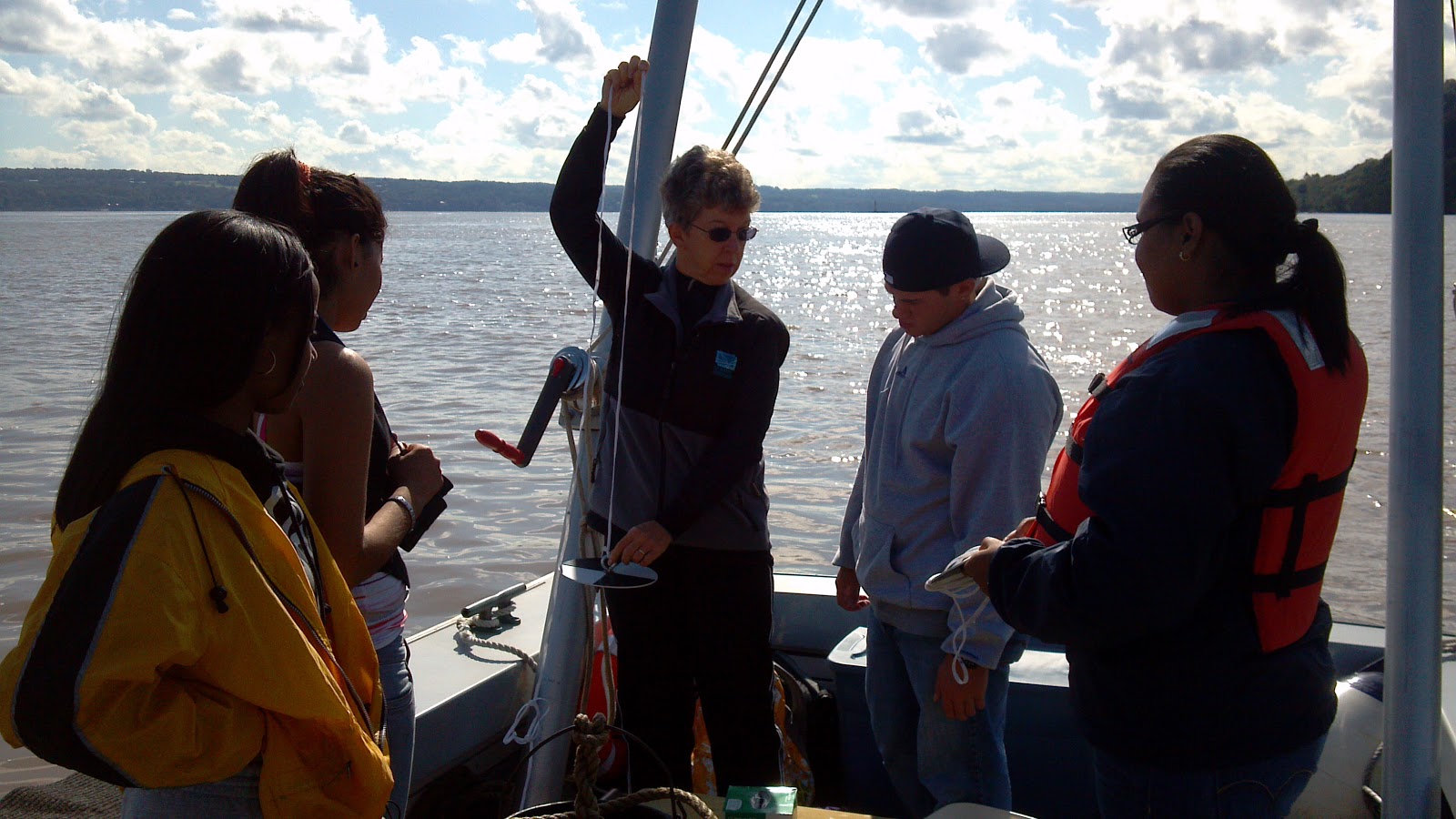
The Riverkeeper boat serves many purposes on the Hudson River, sometimes as a watchdog and patrol vessel, sometimes as a platform for scientific research and water quality monitoring, and sometimes as an ambassador for the river.  This past weekend we were able to fill all of these roles at once while on patrol with ecology students from the College of Mount Saint Vincent.

The focus of the outing was using science to influence policy and letting data "speak for itself," which is a major theme of our water quality research.  Students measured turbidity and salinity while aboard.  The students were also able to learn how about how the river is a giant living being thing that experiences environmental changes constantly. 

We find that the ability to conduct research on the boat instead of in a lab is always a positive experience, especially on a beautiful fall day on the Hudson.


Thanks to Professor Patricia Grove and her students for a great outing!

Captain Lipscomb giving some history of the Riverkeeper boat.
Professor Patricia Grove explaining the use of a Secchi disk to measure turbidity.
Captain Lipscomb showing students what a "hot" water quality sample looks like once it's processed.  The fluorescence indicates Entero growth.
Rob Friedman explaining salinity stratification in the river.


Tuesday, September 27, 2011

Beacon Sewage Overflow

Raw sewage is flowing into the Beacon Harbor from a pipe at the northeastern corner of the harbor.

A member of the public called this sewage release into Riverkeeper's office on Saturday, September 17. Riverkeeper investigated the report, documented the discharge and called it into the NY State Department of Environmental Conservation (DEC) and authorities in the City of Beacon on Sunday, September 18.

Riverkeeper sampled in the area of the discharge on September 23. That sampling confirmed very high sewage levels (>24,196 per 100/ml, the highest our system can read). Based on this data, and the lack of public notification for this ongoing release, today we issued a press release strongly advising the public to avoid contact with the water in Beacon Harbor until the source of the spill has been fixed and testing confirms that water quality has returned to acceptable levels.


Video showing the flow rate of the spill
The blue color of the water is typical for sewage spills

The water is flowing out of this spillway and into the harbor

This is the view of the harbor with the source of the sewage overflow behind you

Debris that appears to be toilet paper clings to the branches of shrubs next to the overflowing pipe
Learn about our push for a Sewage Right to Know Law for New York State
See our historic water quality data for Beacon Harbor

Tuesday, August 09, 2011

"How Is the Water?" Report Released

Today we released our report on sewage contamination in the Hudson River Estuary, "How Is the Water?"

It was a big group effort - 5 years to collect the data and 5 months to write and release the report. I'm sure this will not be our last report on the sewage contamination we are battling. It's just another point in an ongoing conversation.


We were honored to be joined by New York State Senator Adriano Espaillat and New York State Assemblyman Thomas Abinanti. We will be working with both representatives on a Sewage Right to Know law for New Yorkers.


Download the report and learn about patterns and sources of sewage in the Hudson, and view some of the preliminary news coverage:

Monday, July 25, 2011

Massive Sewage Spill in NYC

A catastrophic fire at the North River Wastewater Treatment Plant on the upper westside of Manhattan last Wednesday, July 20th, led to a temporary plant shutdown and the dumping of millions of gallons of raw sewage into the Hudson and Harlem Rivers. The untreated sewage flowed into the water from numerous pipes along the shoreline of Manhattan.

Despite the huge volume of wastewater - an estimated 120 million gallons a day for three days - many city residents were unaware of the spill, or learned of it too late to avoid contact with the contaminated water.


Swimmers in the park just north of the plant on 7/21

We approached them in the patrol boat and warned them


The morning after the fire Riverkeeper conducted the first of three water quality sampling runs in the waters around Manhattan Island, including New York Harbor and sites as far north as the Tappan Zee Bridge.


On Thursday the 21st, the first full day of the sewage discharge, we found extremely high levels of sewage contamination along the west shore of Manhattan, which at the time of sampling, did not extend north to Yonkers or south of the Battery. Sewage contamination was lower in the middle of the river, and still lower on the New Jersey side. In fact, on the New Jersey side, Enterococcus levels were “acceptable” per EPA guidelines.


On Friday the 22nd our sampling indicated similar results, with the highest contamination area being the west side of Manhattan. All sampling occurred before the North River Plant resumed partial operation on the evening of Friday, 7/22. It’s important to note that as of Friday evening, although the contamination pattern was similar and while contamination levels were lower than on the first day of sampling, some areas along the Manhattan shoreline were still very contaminated.


We sampled again today, Monday the 25th. An update with additional data will be posted soon.


In the meantime for more information on the spill:


Monday, July 18, 2011

More Photos from the 8 Bridges Swim

Our friend, Greg Porteus, pilot and foundation president of Launch 5, just sent us these great photos from the 8 Bridges Swim. Thank you again to the event organizers for including us in this incredible event, and congrats on completing the swim!

Jumping in!
Splash!
The Fletcher meets the swimmers

Capt. Lipscomb and Boat and Water Quality Program Staff member, Rob Friedman

It's always a pleasure collaborating with Launch 5


photo credit: Greg Porteus

Tuesday, July 12, 2011

The 8 Bridges Swim


Yesterday we had the privilege of bringing several journalists out on the river to cover the 8 Bridges Swim. The 8 Bridges Swim is running from the Rip Van Winkle Bridge near Catskill to the Verrazano-Narrows Bridge in New York City, covering 120 miles of river. The swim is benefitting Riverkeeper, Launch 5, and Coney Island Brighton Beach Open Water Swimming Inc.

Here's some footage taken by our friends from Launch 5:


And some photos of the swimmers as they were interviewed by a journalist from the Journal News:


Thank you to the 8 Bridges team for including us in their event, and also highlighting the need for improved water quality in the Hudson River.

photo credit: Rob Friedman