Showing posts with label Lamont-Doherty. Show all posts

Tuesday, August 09, 2011

"How Is the Water?" Report Released

Today we released our report on sewage contamination in the Hudson River Estuary, "How Is the Water?"

It was a big group effort - 5 years to collect the data and 5 months to write and release the report. I'm sure this will not be our last report on the sewage contamination we are battling. It's just another point in an ongoing conversation.


We were honored to be joined by New York State Senator Adriano Espaillat and New York State Assemblyman Thomas Abinanti. We will be working with both representatives on a Sewage Right to Know law for New Yorkers.


Download the report and learn about patterns and sources of sewage in the Hudson, and view some of the preliminary news coverage:

Tuesday, October 21, 2008

Testing Water Quality


Scientist Andy Juhl and assistant Carol Knudson from Lamont-Doherty Earth Observatory processing samples. We “cook” the microbial samples for 24 hours at 41 degrees centigrade in our onboard incubator. This equipment allows us to sample day after day on patrol without having to return to the Lamont lab every evening.

Friday, October 19, 2007

LDEO's Acoustic Doppler Current Profiler

Photo by John Lipscomb
Philip Orton of Lamont-Doherty (LDEO) with his ADCP (Acoustic Doppler Current Profiler) which we've just retrieved from the bottom on Tappan Zee. It's been measuring and recording current direction and speed at all depths for over a month.

Thursday, August 16, 2007

Clams in Haverstraw Bay

Photo by John Lipscomb
There are millions of these beautiful little clams in the sediment in Haverstraw Bay. They are a brackish water mollusc called "Rangia cuneata" native to the Gulf of Mexico. They either invaded or re-colonized the lower Hudson in the 1980's. Rangia are harvested in some parts of the eastern U.S. and Gulf of Mexico but eating them here might be risky. 


Riverkeeper/Lamont-Doherty sampling periodically finds violation levels of sewage related microbes in Haverstraw Bay and the local tributaries.


Thursday, May 17, 2007

Checking the water quality in Newtown Creek


We did sampling in the East River with Lamont-Doherty's Greg O'Mullen and his crew, as part of our water quality pilot program. We also patrolled with City Limits Reporter and a PBS film crew.


Discovered a new oil absorb that Exxon installed at Meeker Avenue. This is at the eastern end of the original plume which is migrating. We suspect that the plume has found a new route into the creek.


At the east branch of Newtown Creek we found a discharge from a cement plant. We have had a successful prosecution of another cement plant on the Creek. This is a second plant we’re investigating. We’ve commented on this discharge and it ended. It has since started up again.


Wednesday, April 18, 2007

Gowanus Canal Water Quality - Yuck!

Photos by John Lipscomb
Sample from the bottom of the Gowanus Canal


4/18/07: At the Gowanus Canal we sampled with Lamont-Doherty's Greg O'Mullan, as part of our water quality pilot program.
Wednesday, December 13, 2006

Water Quality Monitoring Study 2006

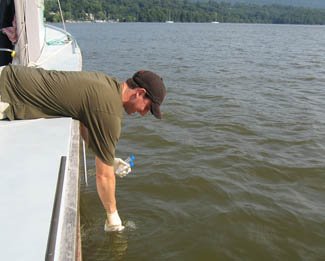
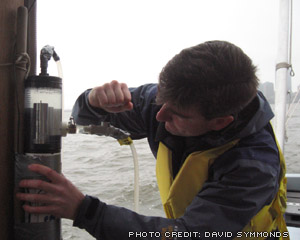
Water quality and sewage indicator sampling with Lamont-Doherty Earth Observatory, Columbia University team - lower estuary from Nyack to NY Harbor. Sample at Sparkill Creek and Piermont, the mouth of the Saw Mill River, at the Yonkers sewer plant discharge, in the Harlem and East Rivers, in Newtown Creek at two locations and at the Battery. This pilot sampling program began during the summer. The preliminary data collected will be used to seek funding for a long term, full estuary study which Riverkeeper and Lamont-Doherty hope to begin early in 2007.


Photos by John Lipscomb

Monday, September 11, 2006

Testing real time water quality monitoring


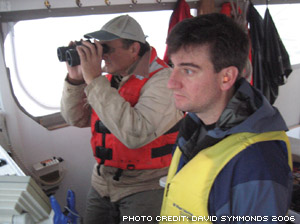
Patrol from Nyack to Garrison with Columbia University/ Lamont-Doherty microbiologists aboard to measure various water quality indicators including bacteria from sewage. This is the start of a pilot program to determine whether “real time” water quality monitoring is feasible using Riverkeeper’s patrol boat.